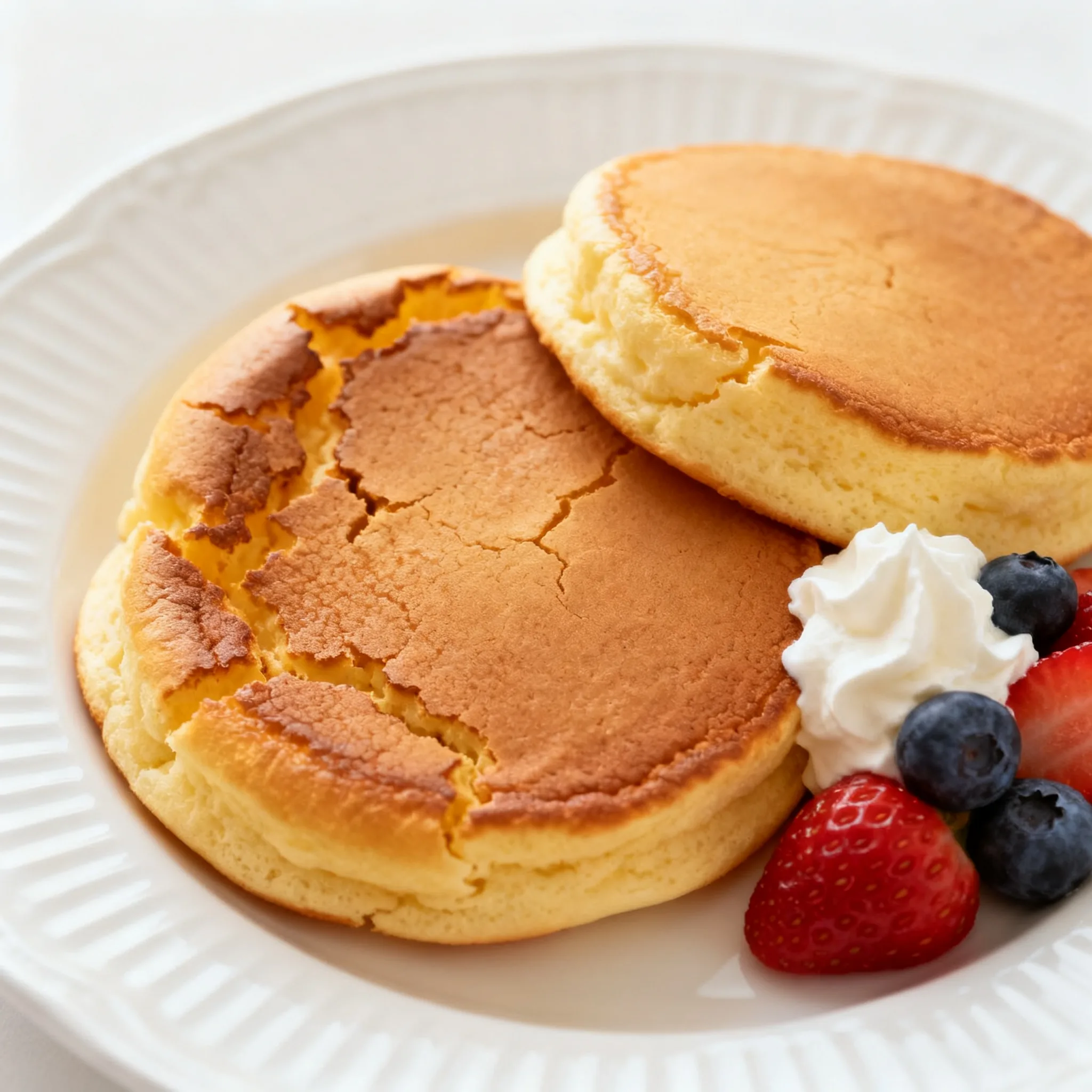
Japanese Souffle Pancakes Recipe (Tall and Fluffy)
This japanese souffle pancakes recipe only puffs into those thick, wobbly towers when two things happen at once: the egg whites get whipped well past soft peaks, and the pan stays on the lowest possible heat the whole time. Most home attempts blow past both rules at once. People treat the batter like regular pancake mix, whites beaten until just foamy, heat cranked up to get a fast sear, lid left off so the kitchen doesn't steam up. The stack rises in the pan, looks great for about ninety seconds, then sinks into a flat, eggy disc the second it hits the plate.
If a tall stack like this has you craving more weekend mornings, I’ve got plenty more ideas in my collection of brunch bakes and quick breads.
I whip my whites until they hold a stiff peak that barely droops when I lift the beater, with a pinch of cream of tartar in there to keep that structure from collapsing the moment it meets warm batter. That meringue is the entire scaffolding of the pancake: there's barely any flour in this recipe, so if the air goes, there's nothing left to hold the shape. Folding has to be gentle too, more like turning pages than stirring, because every hard stroke knocks a little lift out of the bowl.
The other half of the fix is water in the pan: a splash added next to the batter, then a lid on top, turns the inside of that skillet into a low, wet oven instead of a dry griddle. Low heat and steam cook the inside through without ever letting the outside set hard enough to crack under the weight. Give each side close to 5 minutes before you even think about flipping, and you'll get the tall, custardy stack these are supposed to be.
PrintJapanese Souffle Pancakes Recipe (Tall and Fluffy)
Tall, wobbly Japanese souffle pancakes made from a stiff meringue batter, cooked low and slow under a lid for a soft, custardy center.
- Prep Time: 15 minutes
- Cook Time: 15 minutes
- Total Time: 30 minutes
- Yield: 2 1x
- Method: Stovetop
- Cuisine: Japanese
Ingredients
- 2 large eggs, separated
- 2 tablespoons milk
- 1/4 teaspoon vanilla extract
- 1/4 cup (30g) cake flour, sifted
- 1/4 teaspoon baking powder
- 1/8 teaspoon cream of tartar
- 2 tablespoons granulated sugar
- Pinch of salt
- Butter or neutral oil, for the pan
- 2 tablespoons water, for steaming
- Powdered sugar and maple syrup, for serving
Instructions
- In a bowl, whisk the egg yolks with the milk and vanilla until smooth. Sift in the cake flour, baking powder, and salt, and whisk just until no lumps remain; the batter will be thick.
- In a separate, clean bowl, beat the egg whites on low speed until foamy. Add the cream of tartar, raise the speed, and add the sugar a spoonful at a time, beating until the meringue holds a stiff, glossy peak.
- Fold a third of the meringue into the yolk batter to loosen it, then fold in the remaining meringue in two additions, cutting and folding gently until just combined with a few thin streaks remaining.
- Heat a lightly greased nonstick skillet over the lowest heat setting. Spoon the batter into 2 or 3 tall mounds, about 3 inches wide, stacking a second smaller scoop on top of each mound right away.
- Add 1 to 2 tablespoons of water to an empty part of the pan, cover with a lid, and cook for about 5 minutes.
- Add another small scoop of batter on top of each mound to build more height, re-cover, and cook for 5 more minutes, until the bottoms are golden and the sides feel mostly set when pressed.
- Carefully flip each pancake, add another small splash of water if the pan looks dry, cover, and cook 5 minutes more, until both sides are golden and a toothpick comes out clean from the center.
- Transfer immediately to a plate, dust with powdered sugar, and serve right away with maple syrup.
Notes
Wipe condensation off the lid between checks so drips don’t land on the batter and leave bald spots. Don’t crowd the pan: 2 or 3 mounds per batch leaves room to flip without collapsing a neighbor. These settle and deflate slightly as they cool, so serve them the moment they come off the heat.
Why The Meringue Decides Whether These Rise Or Fall
The only real structure in this batter is air, so the meringue has to be built right. Beat the whites on low until they turn foamy and loose, then add the cream of tartar and bring the speed up while the sugar goes in a spoonful at a time. You are looking for a meringue that stands in a stiff, glossy peak and barely slides when you tilt the bowl, not the soft, drooping peak most pancake recipes stop at. Cream of tartar is doing real work here: it’s a mild acid that tightens the egg white proteins so that peak holds instead of weeping once it meets warm yolk batter.
Folding matters just as much as whipping. I fold in a third of the meringue first to loosen the thick yolk base, then add the rest in two more additions, cutting down through the middle and turning the bowl as I go, the way you’d fold a letter rather than stir a bowl of soup. A few thin white streaks are fine. Fully smooth batter means you’ve beaten the lift right out of it, and no amount of steam in the pan will bring it back.
Equipment And Heat Settings That Keep The Stack From Scorching
A heavy nonstick skillet with a lid that actually seals is non-negotiable here, since the whole method depends on trapping steam rather than searing. A glass lid is worth having so you can watch the pancakes rise without lifting it and losing that moisture. Ring molds are optional: they give you clean, tall sides, but a few generous spoonfuls mounded on top of each other, each slightly smaller than the last, will stack up just as tall freehand.
Keep the burner on the lowest setting your stove has, or around 275 to 300°F on an electric griddle. Add the batter in tall mounds, then pour a tablespoon or two of water onto the empty part of the pan, away from the batter, and cover immediately. Cook about 5 minutes a side, checking doneness by pressing the edge gently: it should spring back and feel set, not wet or jiggly, before you flip. If the bottoms are browning faster than the center is setting, your heat is still too high.
Keeping Leftover Souffle Pancakes Soft The Next Day
These are best fresh, but leftovers hold up fine if you handle them right. Let any extras cool for a few minutes, then move them into an airtight container within 2 hours of cooking and refrigerate; they’ll keep for 3 to 4 days. Stack them with a layer of parchment between pancakes so they don’t stick together or flatten under their own weight.
To reheat, skip the microwave on high, which turns the delicate crumb rubbery fast. Warm them in a covered skillet over low heat with a small splash of water for a minute or two per side, the same steam trick that cooked them originally, until they’re heated through to 165°F in the center. Cooled pancakes also freeze well in a single layer for about a month, reheated the same way straight from frozen.
Flavor Swaps And Dietary Variations Worth Trying
Once you’ve got the technique down, the base recipe takes flavor well without losing its lift. Fold a teaspoon of matcha or cocoa powder into the yolk batter before adding the meringue, or stir in citrus zest for brightness. Classic toppings are whipped cream, fresh berries, or a drizzle of maple syrup, but a dusting of kinako soybean powder is a nice change if you want something less sweet.
- Gluten-free: swap the cake flour for a measure-for-measure gluten-free blend; the pancakes will be slightly denser but still rise well.
- Dairy-free: swap the milk for oat or almond milk and use a neutral oil or dairy-free butter alternative in the pan instead of regular butter.
Both swaps work together without affecting the meringue at all, since the eggs do the real lifting in this recipe.
Want Another Pancake Stack Or A Sweet Loaf Next?
If you’re on a pancake kick, my kefir chocolate chip pancakes are a faster, everyday stack with a tangy depth from the kefir. For something to bake ahead and slice all week, the black sesame banana bread with a brown butter swirl has that same nutty, toasted flavor this breakfast crowd tends to love.
Frequently Asked Questions
Why did my souffle pancakes deflate or sink after cooking?
The most common cause is a meringue that never reached stiff peaks, so the batter had nothing to hold it up once it left the pan. The second cause is heat that's too high, which sets the outside before the inside firms up, so the stack collapses as soon as you cut into it.
Can I make the batter ahead of time?
Not really. The meringue loses air within a few minutes of being folded in, so mix right before you cook rather than letting the batter sit on the counter.
Do I need a ring mold to get tall pancakes?
No. Mounding a few spoonfuls of batter directly in the pan, stacking each scoop slightly smaller than the last, gets you the same height without the extra equipment.
Can I use a hand mixer instead of a stand mixer for the egg whites?
Yes, a hand mixer works fine and makes it easier to judge when the peaks turn stiff and glossy, since you can tilt the bowl and check as you go.
Why is the inside still raw even though the outside looks done?
That usually means the heat was too high or the lid came off too soon, so the outside set before steam had time to cook through the center. Lower the heat, keep the lid on, and give it the full 5 minutes per side.
Get our 10 best recipes - free
Join the Receipster newsletter and we’ll send you Dorothy’s 10 most-loved recipes as a free PDF.
Free PDF + new recipes every week. Unsubscribe anytime.